Made to measure vs bespoke at a glance:
| Feature | Made-to-Measure | Bespoke |
| Pattern | Modified block pattern | Custom hand-drawn pattern |
| Fittings | 2-3 | 3-5 |
| Production | Factory-made | Handmade |
| Timeline | 5-7 weeks | 8-12 weeks |
| Fabric Choice | Extensive | Extensive |
| Customization | Basic | Unlimited |
| Price Range | $2,000-7,000 | $7,000-$20,000 |
As a bespoke pattern maker, I’ve written extensively about bespoke suits, but every now and then I have a client ask me what exactly the differences are between a made-to-measure suit and a bespoke suit.
I’ve found a lot of people tend to use the term “bespoke” to mean made-to-measure, as well as referring bespoke.
And while they both can appear to be similar to the untrained eye, the differences are deeper than you think.
This article is here to help you understand the differences made to measure and bespoke, so you not only can figure out what’s best for you, but you can also appreciate a bespoke suit when you see one.
Made to Measure Vs Bespoke Patterns
One of the biggest differences between a made-to-measure suit and a bespoke suit comes down to the patterns.
If you’re not familiar with patterns, check out our article What is Bespoke Pattern Making?
But essentially, a pattern is what’s cut out of the fabric and sewn together.
Made-to-measure suits use ready-made patterns that are modified to fit the wearer’s dimensions, while a bespoke pattern uses an original pattern created exclusively for the wearer.
What this means is that made to measure patterns are constrained in the modifications they can make, while a bespoke pattern is has much more freedom.
For example, if you are tall, have large shoulders and a small chest, a made-to-measure pattern might not be able to take in the chest as much as you need, while a bespoke pattern can
Another example is if you desire your overcoat to fall below your knee, a made-to-measure pattern may only be able to drop to a bit above your knee, while a bespoke pattern can fall exactly where you want it.
Patterns also effect the details.
If you want a lapel width to be 13 centimeters and have a belly on it, most made-to-measure patterns won’t be able to accommodate for this, while a bespoke pattern, because it’s completely made for you, can make it happen.
In essence, bespoke patterns have way more versatility because they’re designed from scratch just for you, while a made-to-measure pattern is made with less versatility because it has to accommodate way more people.
Made to Measure vs Bespoke Production
When it comes to the sewing of a suit, made-to-measure and bespoke suits are completely different.
Bespoke suits are usually made by hand by a small team of tailors while made-to-measure suits are made in factories.
Because of this reason, a lot of the hand work and details that you’ll find in a bespoke suit will be absent in a made-to-measure.
Hand sewing vs machine

Bespoke suits are almost completley made by hand while a made-to-measure suits may have aspects done by hand, but is largely done by machine.
On a true bespoke suit, the only time you’ll see a machine being used is on large seams like the back seam on a jacket, the sleeve seam, or the outseam on a trouser.
Other than that, every other stitch is done completely by hand.
Made-to-measure, however, may have handwork in some places like attaching the sleeve and the collar, the majority of the work is done by hand.
Pick Stitching or AMF
The small stitches done on the lapel and the edge of the pocket is called pick-stitching, and with bespoke it’s done completely by hand.
It’s beautiful to see the imperfect variances of the stitch length and angle.
On a made-to-measure suit, it isn’t called pick-stitching, it’s called AMF, which stands for American Machine and Foundry, the company that invented the pick-stitch machine.
While it’s still a beautiful look to see the small stitches around the pocket and lapel, AMF produces uniform stitches, which is exactly what you would expect out of a machine.
Canvassing
When it comes to the inside of a suit, a made-to-measure suit can have a fused interface, half-canvas or a full-canvas make up.
On the other hand, a bespoke suit will exclusively come with a full canvas.
What’s more, the roll of the lapel with a made-to-measure suit is done with a pad-stitch machine, while a bespoke suit has each pad stitch done by hand, which makes the lapel roll into the body effortlessly.
Button Holes


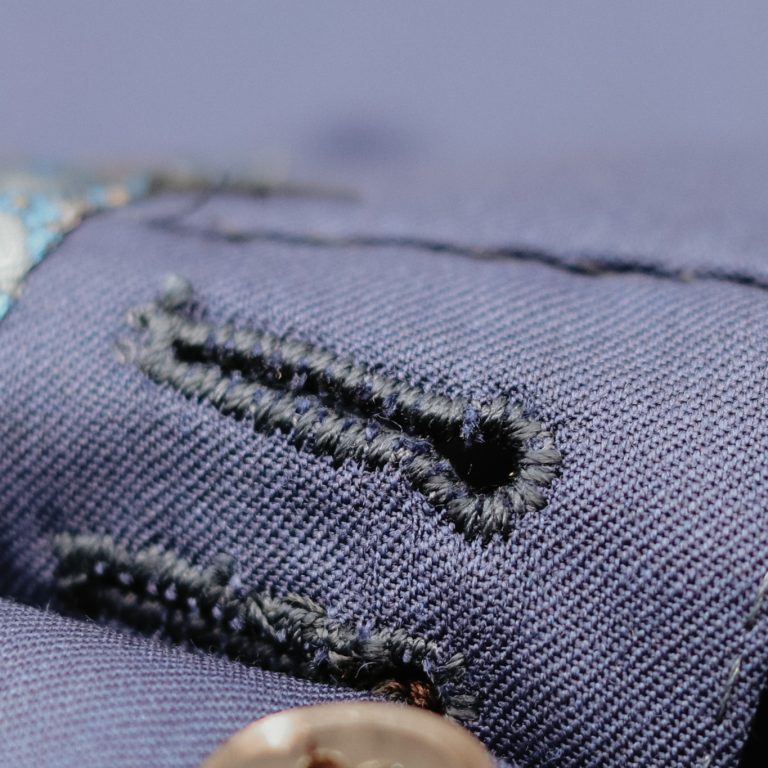
Bespoke suits and made-to-measure suits can both come with handmade buttonholes, but it’s more rare to find these on made-to-measure while it’s the expectation of a bespoke suit that the buttonholes are done by hand.
Made to Measure vs Bespoke Timeline
Another big difference between made-to-measure suits and bespoke suits is how long it takes to make.
Made-to-measure suits typically have less fittings than bespoke suits, and in most cases, much faster produciton times.
Usually, a made-to-measure suit only requires three fittings; one fitting for the initial measurements and design, a second fitting for alterations, and a third fitting to confirm and pick up the suit.
A bespoke suit, however, usually requires at least four fittings, although it really depends on the shop making your suit.
For a 1701 bench-made bespoke suit, the first fitting is for measurements and design details.
About 30 days after the first fitting is the second fitting, in which the garment is temporarily stitched together with basting thread. Here modifications are made in chalk and sent back to the workshop for the changes to be made.
About 30.days after the second fitting, the suit has its final stitching completed, and there’s another fitting to finalize all small details, like the length of the trousers or slight modifications to the waist.
Usually about one to two weeks after the third fitting is the suit ready for pick up.
Because of the extra fittings, and depending on your tailor’s schedule, a bespoke suit will average around 11 weeks, while a made-to-measure will average around six weeks for a turnaround.
Made to Measure vs Bespoke Pricing
The price difference between a made-to-measure suit and a bespoke suit is pretty signficant.
Made-to-measure suits are produced on a factory line, so more suits can be made per day, thus lowering the price.
Bespoke suits, however, require way more hand work, as well as time to develop an original pattern, which means only a certain can be made per year.
I like to compare these suits to artwork; a made-to-measure suit is a print while a bespoke suit is an original painting.
Because of this, made-to-measure suits typically run between $2000-$8000, all depending on the fabric, as well as where the factory is located.
There are cheaper factories in Vietnam, China, and even Mexico that can produce a made-to-measure suit for sub $1000, while at 1701 Bespoke, we aim for high-quality and produce our made-to-measure suits in Italy with a starting price of $2300.
For a bespoke suit, pricing can typically start around $7000, but it’s not rare to see prices between $15,000 and $25,000 these days.
Which is right for you?
When it comes to choosing whether a bespoke suit is right for you versus a made to measure, there are several factors I would consider:
- What is your budget and timeframe?
If you’re in a rush or on a tight budget, made-to-measure is for you. - Fit requirements?
If you have an unusual body shape or proportions, made-to-measure may not work for you. If a perfect fit is your top priority, bespoke is the way to go. - Customization
If you have.a unique vision for a suit, bespoke is the only way to go. You’ll be too constrained with a made-to-measure suit.
At the end of the day, for most people, both suits will look much better than an off-the-rack suit.
However if you want to wear an original piece of art, a suit unmatched in terms of quality and fit, and a suit steeped in tradition, a bespoke suit is the way to go.