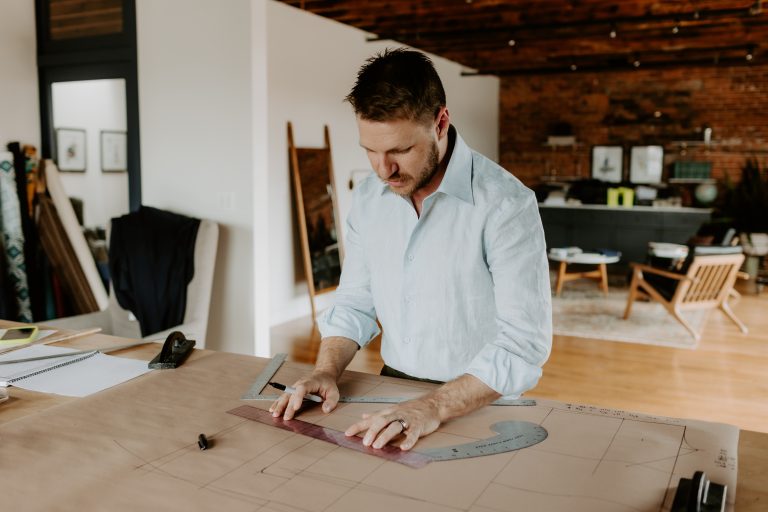
In the world of suits, the highest quality garment you can possibly get is a bespoke suit.
But in my experience, almost nobody knows what a bespoke suit is.
Many assume it means custom, but a “custom suit” could mean a ready-to-wear suit that is tailored, a made-to-measure suit, or a bench-made bespoke suit.
So this article is here to help clarify the difference between these three makes, and hopefully set the record straight on what truly is a bespoke suit.
What is a bespoke suit?
A bespoke suit is a suit made from an original pattern that is drawn by hand, cut by hand, and sewn by hand.
Most suits are either ready-to-wear or made-to-measure, because they are derived from patterns that have already been made off of a mannequin or model.
A bespoke suit is different because the pattern is made for just one person: the wearer.
But what exactly is a pattern?
What is a pattern?
A pattern is what is cut out from the fabric and then sewn together.
Patterns are the key essence in a suit.
It’s the blueprint that determines how a suit is shaped, styled, and how it fits.
When a fashion company is developing their suiting line, one of the first things they do is get a pattern maker to draw the initial look of their suits.
However, because pattern making for suits is a dying skill, a lot of companies do not employ a bespoke pattern maker.
Instead they copy.
Tom Ford famously developed his patterns by buying bespoke suits from Savile Row, taking them apart, then copying the patterns to make his original pattern.
Other factories buy “blocks,” or pre-made patterns and make slight changes to fit their style.
And other factories buy the copies of the blocks, or copies of copies of the blocks.
This leads to a degradation in the patterns, and can ultimately lead to a clumsy fit, which is why some brand produce amazing looking suits, while other brands never get it right.
How are bespoke patterns made?
Since bespoke patterns are unique and are only made for one person, the very first thing that must be done to make a bespoke pattern is the measurement process.
Each pattern maker has preferred measurements that they use in order to build the perfect pattern, but some of the most influential measurements I use are the height and the chest size.
While everyone looks different and appears to have different proportions, one of the constants of the human body is the length of limbs in relation to the height of the head.
Using the height, I can determine roughly how long a coat should be, how long the arms should be and where the button point is.
The chest is also a key measurement because not only does it determine the size of the chest, but it determines where the arm hole, how wide it is, as well as the front length of coat, the size of the pockets, and the size of the lapel.
Using just these two measurements alone, I can put together almost a complete pattern.
Bespoke Tailoring Systems
After the measurements are taken, the pattern making process begins, in which the bespoke pattern maker starts to define the fit of the suit
One aspect that changes depending on the pattern maker is the easement or how much extra space on top of the skin measurements each piece of the suit will have.
For example, a slimmer fitting suit will have less easement in the waist and chest in order to create a tighter fit, while a traditional style suit will have more easement, creating a fuller silhouette.
This easement is usually dependent on what bespoke pattern making system the pattern maker decides to use, as well as the preferences of their customer.
There are a handful of systems used all around the world by bespoke pattern makers such as the Double-Balance System, the Thornton System, the Rundschau System, and what i use; the Imperial System.
There are slight differences in each system, but at the end of the day, all systems used to create patterns will yield the same result.
Tradition Passed Down
One of the greatest things about bespoke pattern making is its emphasis on lineage and traditionalism.
For example, I was taught by a bespoke tailor who worked at Henry Poole, the first bespoke suiting shop in the world. The methods I use to craft a bespoke pattern are very close to the original techniques developed by James Poole, the founder of Henry Poole, over 220 years ago.
While there have been slight adjustments over time—like moving from a one-piece to a two-piece front—and evolving style preferences, the fundamentals remain the same. When you wear a bespoke suit, you’re stepping into a garment that’s built on centuries of craftsmanship, a lineage of expertise passed down from one generation to the next. Every stitch, cut, and measurement is rooted in techniques perfected over hundreds of years, connecting you to a tradition that values patience, precision, and personalization.
It’s a rare thing today to find an art form so untouched by time, and that’s exactly what makes wearing a bespoke suit such a unique experience.

