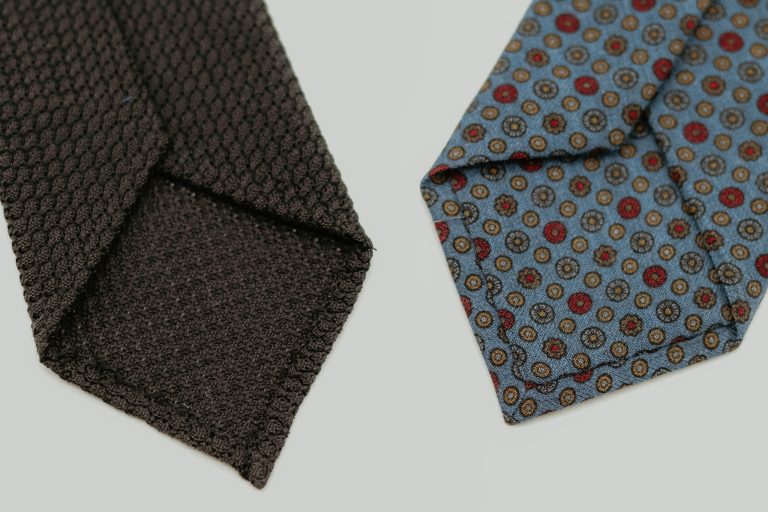
In a previous article, we made the case why you should get a handmade tie, and in it we briefly covered the types of fabrics you can get in a tie.
However, there’s a lot more to be said, and if you truly want to be an expert on ties, this article is going to get you there.
Choosing the right fabric of a tie effects everything from how the tie knots, to how it complements your outfit.
In this article, we’ll explore the common types of fabrics for ties, and when to choose each.
Silk: The Gold Standard
Silk is the first thing everyone thinks of when it comes to ties
It’s smooth, durable and has a natural sheen which is why it’s considered so elegant.
I mostly wear silk ties because of its versatility, but it’s important to make the distinction between the different types of silk ties:
Woven Silk vs Printed Silk
Woven silk means the pattern design on the tie is created by weaving different colors of yarn together, while printed silk means the yarns are dyed a uniform color and the design is printed on the fabric afterwards.
Solid colored ties tend to be woven silk because the silk printing process is much more extensive than dyeing individual yarns.
Modern silk printing uses digital printers to print designs, but before the digital era, screen printing was the most common way of creating designs.
Grenadine Silk
True grenadine silk is exclusively produced in Como, Italy and is open-weave silk that is often confused with a cotton knitted tie, but has the distinguishing sheen of silk.
There are two types of grenadine silk: garza grossa and garza fina.
Garza grossa, meaning thick gauze, is a looser weave and gives the tie a more textured appearance.
Garza fina, meaning fine gauze, is has a tighter, finer weave, and while still having some texture, appears more solid versus the garza grossa.
Both types drape beautifully and add depth to an outfit without overwhelming it.
If you only have room in your closet for one tie, I recommend a dark navy garza grossa grenadine
Ancient Madder
Ancient madder ties, getting their name from the madder plant that creates the dye, have a unique soft texture.
They have more of a matte finish compared to woven and printed silk ties, and uses a traditional dyeing process, which is why the colors aren’t as vivid.
Unlike printed silk, in which the dye coats just the surface of the silk fibers, the dyeing process for ancient madder involves immersing the silk in a multi-step process, allowing the dye to penetrate deep into the fiber.
After the fibers are dyed, a gum arabic, a type of tree sap, is applied as a finish, which enhances the muted, dusty tones ancient madder is known for.
While printed, woven and grenadines are great ties to wear all year round, in general, ancient madder is best worn in the fall/winter because of its muted colors.
Shantung
Shantung silk ties are the most luxurious silk ties you can get.
They resemble raw silk with an uneven texture and ridges (known as slubs), that create perfect imperfections that give each tie a unique characteristic.
These ties typically have a matte finish and an organic feel that adds character to casual and semi-formal outfits.
Shantung ties are often used to create a more relaxed outfit, yet still sophisticated, so they’re perfect for summer events not-so-serious business occasions.
Wool: Texture & Warmth
Wool ties are known for their texture, and in some particular weaves of wool, their bounce.
I personally wear Fresco fabric ties because they knot beautifully and rarely leave a crease after I’m done for the day.
Because the Fresco is a thinner wool with a slight sheen, it can often be mistaken for a solid silk tie, and is a perfect fabric for multiple fold ties like the 7-fold.
However, outside of 1701, wool ties are typically thought of as a winter tie because it uses a thicker material, heavy on texture.
You’ll often see wool paired with silk as well, to create a textured tie with a sheen, allowing the tie to be worn just outside of fall/winter, but in general, a traditional wool tie is usually worn in the colder months.
Cashmere: The Pinnacle of Luxury
My favorite tie to wear in the winter is a cashmere tie.
They’re rare and highly sought after, offering unparalleled softness, with the unique benefit of keeping you warm versus a silk tie.
The cashmere fabric helps to trap your neck’s warmth and radiate it slowly through the day, actively keeping you warm, so it’s perfect for the colder days.
I usually recommend cashmere ties with regular business suits or a night out but would avoid pairing a cashmere tie with any formal outfit such as a tuxedo.
Linen: Lightweight and Casual
Linen ties are great for the spring/summer but personally, they’re my least favorite type of tie to wear.
I’m a big fan of linen in the summer time for suits, shirts and trousers, but I avoid linen for neckties because of the wrinkles.
Nobody likes a wrinkled tie, and if, for instance, my seatbelt is fastened over my tie for an extended period of time, I’ll end up with it looking funny all day.
It’s my recommendation to stick to silk for the summer time and avoid linen ties all together.
The Last Word
There’s a lot to be said about tie fabrics and how you can pair them with your outfit to enhance your look, and more importantly, dress appropriately for the season.
I love the power of details, which is why every tie we offer is handmade with fabrics specifically chosen to help cultivate your look.
Check out our shop for some ready made ties, or contact me if you’d like to commission a special tie just for you.

