The late 18th century was a transformative period for the textile industry.
As the Industrial Revolution took hold, never before seen inventions reshaped how fabric was made, pulling millions out of poverty and creating new industries from the ground up.
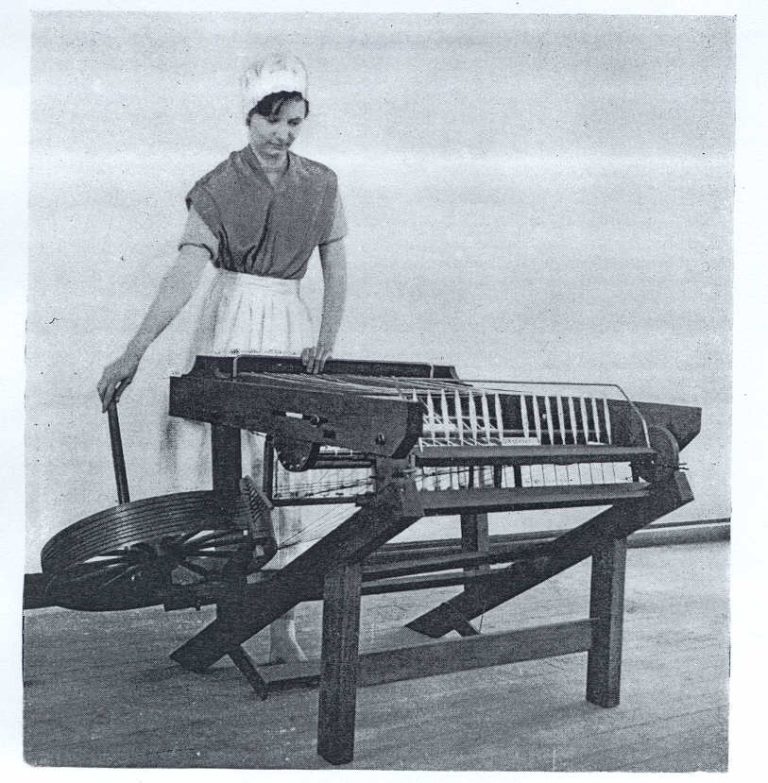
But before the machines powered everything, one of the great inventions that helped blossom the fabric industry was the spinning jenny.
This machine allowed one person to do the work of a dozen others by spinning multiple bobbins of yarn at once, multiplying productivity and setting the stage for modern textile manufacturing.
But like all transformative innovations, it didn’t arrive without controversy.
This article is about the ingenuity, resistance and a name still tied to launching the textile in England.
How Spinning Works
To appreciate the impact of the spinning jenny, you need to firest understand the basics of spinning.
Spinning is the process of transforming raw material into yarn that can be woven into fabric.
Historically, this was a slow and labor-intensive task.
Raw material, such as cotton or wool, is fed through a simple machine twisted tightly, and spooled onto bobbins — powered by nothing more than a foot petal.
It took practice and patience to spin yarn, which is why spinning was often a family trade, passed down through generations.
To see the traditional spinning process in action, check out this video:
The Innovator From Oswaldtwistle
James Hargreaves changed all of this.
Born in a small town in Lancashire village called Oswaldtwistle, he lived in a region that was both a center of textile production and a tough place to survive.
Roads were poor, supplies scarce, and the locals were known for tough demeanor.
Hargreaves, however, stood out for his ingenuity.
Although illiterate and living in poverty, he was known as a skilled spinner and an innovator within the weaving trade.
He even developed new ways to card wool, combing fibers into long strands to make spinning easier.
But his true breakthrough came later.
Commission Your True bespoke suit
Each bench-made bespoke suit is made from the finest Italian and English fabrics, the pattern hand drawn from scratch, and over 50 hours of handwork is put into each coat. Regular fittings appointments available in Detroit, New York City and Los Angeles. Other locations may be available upon request.
Only 100 bespoke suits are made per year, so inquire below for availability.
The Birth of the Spinning Jenny
Sometime around 1764, James Hargreaves and his family are spinning wool in their house, when his young daughter, knocks over a spinning wheel, brining the wooden machine over to its side.
An idea hits Hargreaves; what if multiple spools could be spun at once using a single wheel?
Hargreaves quickly set to work building a prototype.
By the end of the year, he had created a machine that could spin eight bobbins of yarn simultaneously.
This innovation dramatically increased efficiency and productivity, giving Hargreaves and his family a competitive advantage.
Realizing the value of his invention, Hargreaves initially kept his machine a secret to keep his competitive advantage.
And over the next few years, Hargreaves made modifications to perfect the machine, building a few more and selling them to exclusively to his family.
All the while, Hargreaves was building a reputation for himself and his family as the most efficient spinners in the area.
However, sometime in 1768, word got around in Oswaldtwistle about Hargreaves invention and the local villagers weren’t happy.
Resistance to Progress
Resistance to innovation in the textile industry is a recurring story, often fueled by fears of job loss and wage cuts. READ: The Jacquard Loom Riots
The spinning jenny was no exception.
Just like the Luddites who came 50 years after Hargreaves, the local villagers decided that Hargreaves efficient spinning jenny would lead to less spinners employed in the industry.
So one night, the villagers broke into Hargreaves home, ransacked his house and smashed his spinning jenny machine.
The cruel irony is if the villagers embraced Hargreaves, they would have all been able to put his machine to work in their village.
But unfortunately for them, Hargreaves decided to leave Oswaldtwistle for Nottingham, taking his machine and further innovations away from his neighbors.
There, after working for a man named Shipley building his jennies, Hargreaves went into business with a man named Thomas James, to build a cotton spinning mill.
The Patent Battle
In 1770, Hargreaves secured a patent for the spinning jenny, which by then could spin up to 16 bobbins at once.
Confident in his rights, he began to sue manufacturers who had copied his design.
Unfortunately for Hargreaves, his earlier decision to sell jennies in Oswaldtwistle weakened his legal claims.
The machine had already spread beyond his control, making it impossible to enforce his patent
Despite the setbacks, Hargreaves continued running his mill, relying on its modest profits to sustain his family.
The Hargreaves Legacy
James Hargreaves passed away in 1778, but his contribution to the textile industry was profound.
The spinning jenny laid the foundation for future innovations, inspiring a wave of mechanical advancements in Lancashire and beyond.
Every major leap in textile production built upon the ideas of earlier inventors, creating a legacy of collaboration and ingenuity that defined the Industrial Revolution.
The spinning jenny wasn’t just a tool for making yarn faster—it was a symbol of progress, a reminder of the transformative power of human creativity, and a catalyst for one of the most significant economic shifts in history.
The Last Word
But this story also captures the tension innovation creates.that we see all throughout the history of textile innovation.
What happens to the workers whose livelihoods are disrupted? Do we, as a society, have a responsibility to support those who are displaced by progress? If so, what do we do?
Technological advancement has the double edged sword of promise and peril. It challenges us to think about how we embrace change and how we balance compassion for the people it impacts.
This balance remains as relevant today as it was in Hargreaves’ time.

